Proposal: Support Squad Pilot (Weaver + Scribe Model)

Experiment to Enhance Continuity, Clarity, and Coordination Across Scroll DAO

Summary

This proposal suggests launching a 3-month pilot to test the Support Squad model, composed of two complementary roles: Weaver (relational coordination and facilitation) and Scribe (operational documentation and continuity). These contributors would be embedded across all active councils in the DAO, supporting rhythm, coherence, and shared learning without holding decision-making power.

Both roles would report to the Execution Oversight Council (EOC) ensuring that execution is not only monitored, but also understood and improved upon. Their function is not supervisory, but foundational: reduce friction, capture learning, and remove blockers. They act as support infrastructure that strengthens organizational memory and inter-team coherence.

If successful, this structure could evolve into a long-term investment in organizational resilience, especially valuable as the DAO scales its operations.

Motivation

Understanding the Problem

As Scroll DAO grows, we face increasing coordination complexity:

  • Autonomous councils operate in silos, with little systemic alignment.

  • Meeting practices vary widely, often lacking proper facilitation or follow-through.

  • Contributors miss updates, duplicate efforts, or struggle to locate past decisions.

  • No current structure provides connective support between DAO bodies.

This lack of scaffolding results in operational drag, missed insights, and increased fragmentation.

Intended Impact

This proposal aims to:

  • Strengthen operational continuity through a consistent support layer.

  • Increase clarity around what is happening, where, and why.

  • Reduce the need for reactive reporting by supporting real-time learning loops.

  • Create infrastructure for learning-based accountability, where mistakes can be acknowledged without fear and improved upon.

  • Complement the mission of the EOC with day-to-day implementation insight.


Execution Plan

Practice

We propose the creation of a Support Squad composed of:

:knot: Weaver (Facilitative Role)

  • Participates in all council meetings as a process facilitator.

  • Opens meetings with a quick ADMIN block (Attendance, Duration, Minutes, Information, Next Meeting).

  • Shares context from other councils and DAO-wide developments.

  • Helps design and steer the rhythm of meetings, ensuring inclusive and intentional participation.

  • Identifies misalignments and system friction, and collaborates on solutions.

  • Bridges communication between operational councils and the Execution Oversight Council.

:memo: Scribe (Documentation & Continuity Role)

  • Works in close partnership with the Weaver to prepare meeting agendas and facilitate shared agreement on them.

  • Captures clear and structured notes, including agreements, tensions, and next steps.

  • Tracks agreements in a shared registry and flags when topics require review.

  • Helps systematize learning by identifying recurring tensions or best practices.

  • Supports onboarding by maintaining up-to-date documentation and templates.

Together, the Weaver and Scribe form a duo that does not vote or lead decisions, but provides essential connective tissue for the DAO’s healthy operation.


Working Group Size

  • 2 people: 1 Weaver, 1 Scribe

  • Operate across all councils + report to Execution Oversight Council

  • Engage with council leads and contributors

  • Collaborate with governance team, community members, and onboarding support when needed


Term

  • 3 months (pilot period)

  • Start: October 2025

  • Retrospective and assessment in January 2026


Time Commitment

Given the scope of presence, coordination, documentation, and systems improvement, we propose:

  • ~20 hours per week per role

    • Attending ~6–8 hours of meetings

    • Preparing agendas and materials

    • Writing documentation and reports

    • Engaging in retrospectives, follow-ups, and learning systematization

    • Contributing to DAO-wide rhythm and alignment

This level of availability is key to building a stable operational core and reducing systemic coordination costs.


Selection Criteria

Candidates should demonstrate:

  • For Weaver:

    • group facilitation skills,
    • presence across cultural contexts,
    • strategic thinking,
    • capacity for relational coordination,
    • agile management.
  • For Scribe:

    • strong written communication,
    • attention to detail,
    • operational memory,
    • and long-term mindset.
  • Both:

    • Commitment to transparency, mutual respect, and systems-level learning
    • Availability for consistent weekly contributions and responsiveness
    • Familiarity with DAO tools (Notion, Discord, Agora, forum, etc.)

Core Responsibilities

Role Key Duties
Weaver Facilitate meetings/check-ins, share cross-council context, support meeting flow, assist with sensing and alignment
Scribe Co-design agendas, document and publish meeting notes, manage agreement registry, support onboarding and knowledge continuity
Both Report to Execution Oversight Council monthly, identify patterns for learning and improvement, support operational transparency across DAO

Budget Request (in SCR)

Item Monthly Duration Total (USD)
Weaver Compensation $1,500 3 mo $4,500
Scribe Compensation $1,500 3 mo $4,500
Coordination Tools (shared) $100 3 mo $300
Total $9,300

At the exchange rate of $0.3490 USD/SCR, this equals approximately 26,651 SCR.

*Examples: AI notetakers (e.g. Tactiq, Fireflies), shared cloud docs, scheduler tools, backups

This amount supports dedicated operational roles and tooling for improved coordination across all councils. If approved, the Foundation may assist in recruiting qualified contributors or provide support directly.


Evaluation

Learning Metrics

  • Are meeting rhythms and documentation becoming more consistent?

  • Do contributors report better clarity, alignment, and follow-up?

  • Are tensions identified earlier and addressed more effectively?

  • Are learnings being documented and reused across councils?

Stories We Hope to Hear

  • ā€œIt’s easier to participate meaningfully now.ā€

  • ā€œI finally understand what other councils are working on.ā€

  • ā€œDecisions aren’t getting lost or forgotten anymore.ā€

  • ā€œWe’re starting to see patterns and improve our governance design.ā€


Requirements

  • Access to all council meeting calendars, channels, and documentation tools

  • Clarity of mandate and collaboration with Execution Oversight

  • Alignment with Foundation for implementation support if needed

  • Orientation or onboarding sessions with council leads

  • Community buy-in and council consent for integration


Safety

  • Supportive roles, no decision-making power

  • Monthly feedback loop with EOC

  • Full pause or revision possible with mutual agreement

  • Pilot ends after 3 months unless renewed by vote


Conclusion

The Support Squad model offers a simple but powerful solution to a complex challenge: how to maintain cohesion, accountability, and care in a decentralized system.

By committing resources to this experiment, Scroll DAO would be investing in its own nervous system, a set of practices and people that weave together our contributions, without adding friction or centralization.

This proposal is submitted with openness to feedback and iteration. We invite DAO members, Foundation allies, and council contributors to join us in refining and testing this pilot, starting in October 2025.

Feedback warmly welcomed. Let’s keep learning together.

7 Likes

What is your overall impression of the Support Squad (Weaver + Scribe) pilot proposal?

  • :rocket: Sounds promising, worth testing as proposed
  • :test_tube: Interesting, but needs adjustments
  • :thinking: I’m not convinced yet
  • :cross_mark: I don’t think this is a priority for the DAO
0 voters

How valuable do you think these roles (Weaver & Scribe) could be for improving Scroll DAO’s coordination?

  • Extremely valuable – we need this layer
  • Moderately valuable – could help in some areas
  • Not very valuable – not sure it solves our current pain points
  • Unnecessary – DAO functions fine without it
0 voters

What would you prefer as next step?

  • :white_check_mark: Approve and launch the pilot
  • :counterclockwise_arrows_button: Run a community workshop to refine it
  • :open_mailbox_with_raised_flag: Merge with the Execution Oversight Council discussion
  • :stop_sign: Pause until we have more clarity on DAO org structure
0 voters
1 Like

GM!

How you guys doing?

@coffee-crusher @Miana @connormcmk @SEEDGov @GozmanGonzalez @mexi @bitblondy @guiriba @Sixty @Kene_StableLab

I look forward to any comments or suggestions for improvement you may have.

:folded_hands:

6 Likes

I really like this idea, especially since the scribe would maintain a shared registry to track individual council meetings in one place. This makes it much easier for new delegates or anyone who misses meetings to follow conversations and understand past decisions without digging through multiple notes or recordings, while the Weaver helps facilitate cross-council coordination.

I’m curious if there’s a rotational cycle or any other mechanisms that ensure continuity while preventing a small group from unintentionally influencing the tone or decisions over time?

2 Likes

Interesting proposal Alex. I have a few questions though:

  • What are the primary quantitative metrics and KPIs for success during this pilot? How will learning metrics be tracked and made visible to the DAO?
  • How will the monthly reporting to the EOC be structured? Will outputs be public, summarized, or confidential? What are the escalation protocols if issues arise?
1 Like

I really like this idea at first glance. However, the EOC has not yet been ratified by governance, but it should be by the end of the September voting cycle.

Is there a world where these two roles would be an extension of the EOC, instead of a seperate working group? I see the value in documenting the operations of various councils, but I think the budget can fit into the EOC instead of having another working group.

In terms of the time commitment and compensation, I am aligned on those points.

4 Likes

This is a solid step toward improving coordination :clap:. I really like the Weaver + Scribe approach, it feels like it covers both the social and technical gaps.

One thing I’m curious about though: how do we make sure this doesn’t create too much dependence on just a few people?

Would be great to see how knowledge and process get distributed so it’s sustainable long-term.

1 Like

Hello @alexsotodigital , thank you so much for this proposal, as I feel a communication and coordination team is needed for learnings, identifying stop gaps and increasing the organization between the groups, including the EOC.

I do have some thoughts if you could address regarding my leanings towards @Kene_StableLab comment as I also agree that the Weaver and Scribe should be part of the EOC, not just reporting into this group. I see that the W & S roles should be added to both the team roles for the EOC proposal but also to their budget to accommodate their activities.

If the EOC’s purpose is to oversee the many Councils, than two individuals on their team for assisting with communications, shared learnings amongst teams and coordination is a necessary addition. Their work will assist the entire EOC team with having a real insight into each councils activities, rather these councils just reporting to the EOC, it will be a more dynamic and real-time of the activities of group, as well the bridge for each groups shared learnings and communications.

Finally, I would add one caveat to the consolidation into the EOC team for the W & S roles, is to keep it as a 3 month pilot to test the effectiveness of the team, and quantitative KPI’s should be added to test this theory that it will increase learnings and coordination.

1 Like

Thank you for the proposal @alexsotodigital !

I would like to echo some of the thoughts shared by @Kene_StableLab and @coffee-crusher .

I think it would be more productive for now to incorporate these roles as one of the first projects of the EOC mandate if it is voted). My reasoning is that currently, there are a lot of moving pieces with each new council being established, and I think the support squad might struggle to set the groundwork by themselves. Incorporating this as part of the EOC, with the thought of maybe decentralising later, might be a more efficient approach.

5 Likes

GM!

Thank you all for the thoughtful engagement and generous feedback (@miana, @Kene_StableLab, @coffee-crusher, @GozmanGonzalez, @pmprojectz, @bug_hunteress)

It’s clear this conversation is surfacing valuable nuances, both for this pilot and for how we think about support, oversight, and operational resilience in Scroll DAO more broadly.

I’d like to respond to some of the core themes that have emerged, with a few updates and clarifications based on your questions.


On EOC Integration vs. Separate Working Structure

There’s strong alignment that the Weaver + Scribe roles should support the Execution Oversight Council (EOC), and that’s by design. Their core function is to track council workflows, facilitate information flow, and surface systemic tensions that might otherwise get stuck or overlooked.

That said, this pilot is also meant to test a broader concept: a Support Squad that acts as a persistent, cross-council coordination unit.

What I mean is that the Support Squad could eventually include other roles that address common needs across all councils, such as:

  • Tech support (e.g. tool integrations, AI automation)
  • Communications & design support
  • Admin & grant operations support

So the question becomes: How might we structure this relationship (between EOC & W+S) without losing that longer-term support vision?

Some ideas on that front:

  • Keep the Support Squad as a separate working squad, but formally embed it within the EOC’s reporting lines and coordination rhythms.
  • Reduce the proposed EOC size from three seats to two, and delegate some operational responsibilities to the Support Squad.

It would recognize the complementarity of the roles, without conflating decision-making authority. Remember: Weaver + Scribe would have no decision-making power in the councils they support, their role is logistical, not political.

That is, think of Weaver + Scribe as the people responsible for reporting (in green) and removing any obstacles that arise.

Remember this would reduce the coordination burden on the EOC and the Foundation (who currently plays this coherence role) while decentralizing operational knowledge into shared roles in the DAO.


On Metrics and Reporting

On the clearer KPIs. Here’s a refined proposal for what we might track during the 3-month pilot:

Quantitative Metrics

  • :white_check_mark: # of council meetings documented (and time to publish)
  • :white_check_mark: # of retrospective insights reported to the EOC
  • :white_check_mark: % of council members who say the squad ā€œreduced operational burdenā€ (vs. making things more complex)
  • :white_check_mark: % of attendees who report improved clarity/flow during meetings

Learning Indicators

  • :pushpin: Did the support squad help resolve duplicative efforts across councils?
  • :pushpin: Were onboarding processes or recurring issues flagged and improved?
  • :pushpin: Did participants feel safer acknowledging mistakes or raising issues?

Reports could be:

  • Weekly (async) internal logs or dashboard updates to the EOC.
  • Monthly public forum posts with insights (I guess we’ll have to define a threshold for what qualifies as sensitive/non-sensitive information)

On Continuity, Rotation & Sustainability

Some concern was raised about over-reliance on just two people.

Certainly, the idea is for these roles to have defined cycles without the possibility of repetition, which would force rotation. I’m simply wondering if one year is a more appropriate period (to avoid consistency between council sit changes).

Here are other ways to balance that risk:

  • No decision-making power: The squad observes and supports, but never votes within councils, they operate with neutrality.
  • Staggered transitions: In a future stage, new weavers/scribes could join 2 months before the outgoing ones leave, allowing for shadowing and smoother handoffs.
  • Future scaling: If more than 5 councils are active, I would recommend running two weavers + two scribes to distribute load, cross-check insights, and avoid bottlenecks. That would also reduce dependence on an individual.

The idea is to encourage long-term knowledge retention, while also giving room for fresh energy and distributed ownership.


Final Thoughts

Whether we frame this as an extension of the EOC, a separate support unit, or something hybrid, the direction feels clear: we need connective tissue in the DAO: roles that foster shared awareness, prevent silos, and reduce fragility.

Happy to revise the proposal to reflect any consensus that emerges (including merging the budget into the EOC or adapting the structure).

I remind you that tomorrow, September 4th, there will be a Delegate Proposal Bonanza for the EOC where we can reflect together on some of these points. More info in the gov Calendar.

Anyway, I look forward to your comments on my comments. :sweat_smile:
Thanks again for helping refine this.

:folded_hands:

4 Likes

I was initially supportive of the Support Squad being integrated as part of the EOC.

But after reading @alexsotodigital’s comment, I believe there is value in keeping these two functions separate. The EOC has a clear mandate, which is very different from what the support squad will be doing. The Support Squad, while just an experiment for now, should be a group that continues to function and scale as the DAO grows.

The support squad in my eyes will eventually be something akin to a DAO Operations team, and rather than being part of the EOC, they should also be one of the groups continually audited by the EOC to ensure continued excellence.

1 Like

Hi there!

Catching up to this discussion! So first of all we do wanna stress that coordination and cohesion are definitely some of the key aspects that make up for succesfull DAO. In decentralized enviroments, as we all know, this is particularly challenging so we celebrate this being discussed.

In that sense, we do consider that we are upon the first iterations of Scroll Governance which are now reflecting in the Councils being voted. The effectiveness of those Councils is yet to be proben so we’d be careful in adding additional structures or layers that although might sound promising they can traduce in overhead and operations being swamped.

We think that the Council structure sustains in the possibility of actually making decisions and allocate funds based on their scope and design. It’s still way too early to determine the impact of their activity but they are entrusted to execute on the DAOs best interest and that is what we think should be prioritized at this point.

On this basis, the coordination between councils is practically built into the EOC design since it should actively engage with them and their projects in order for the EOC to meet it’s purpouse. This of course should be both to accomplish the oversight activity but also to prospectively enhance DAO operations and bring cohesion to all the moving pieces.

Moreso, we think that the Key Duties set for the Support Squad fall right into the Council members scope already. Seeing EGC actively engaging in the forum, calls and carefully documenting their steps is a good example of how Councils should operate and communicate. It is true that it can become burdensome, but that discussion should fall into the number of Council seats and if they can be shared rather than having a separate dedicated team.

3 Likes

GM! :nerd_face:

Thanks @SEEDgov for sharing your thoughtful reflection. I really appreciate the grounding reminder that we’re still early in Scroll DAO’s evolution, and that we should move intentionally when designing new structures.

Given the EOC’s mandate as a cross-council operational and accountability body, I agree it’s essential that any new working group or role be aligned and not duplicative.

I’d like to zoom in the emerging question: should the Support Squad be folded into the Execution Oversight Council (EOC)? Or does it make sense to keep these roles distinct — while maintaining close operational coordination?


What do you think?

  • The Support Squad should be folded into the Execution Oversight Council (EOC)
  • It make sense to keep these roles distinct, while maintaining close operational coordination
0 voters

Here is a short ā€œNegation Gameā€ exercise that outlines pros and cons of the different approaches. I hope it’s a good start.

(anyway, it helped me continue exploring the tool. More feedback to come @connormcmk).


After all this, tbh, I believe the Support Squad Pilot still makes sense as a lightweight experiment, as long as it’s designed to interface directly with the EOC rather than operate in isolation.

Why keep the Support Squad distinct?

Rather than folding the Weaver and Scribe roles into the EOC or discarding the pilot entirely, I’d suggest seeing the Support Squad as a complementary operational layer.

A support function that:

  • Attends and documents council meetings,
  • Helps share context between councils,
  • Surfaces operational frictions early,
  • Reduces overhead for council leads,
  • And feeds into the EOC’s reporting cycles and dashboards.

This setup helps the EOC stay lean and strategic (High-level monitoring & reporting), while the Squad handles more granular connective work (On-the-ground coordination & process). The Squad’s outputs directly enrich the EOC’s reports, improving their fidelity and insight.

The EOC asks questions, enforces expectations, and intervenes when necessary.
The Support Squad builds context, stitches conversations, and smooths operations.

Blending both into one unit risks muddling the power dynamics, making support feel like surveillance, and diluting the EOC’s authority by pulling it into day-to-day logistics.


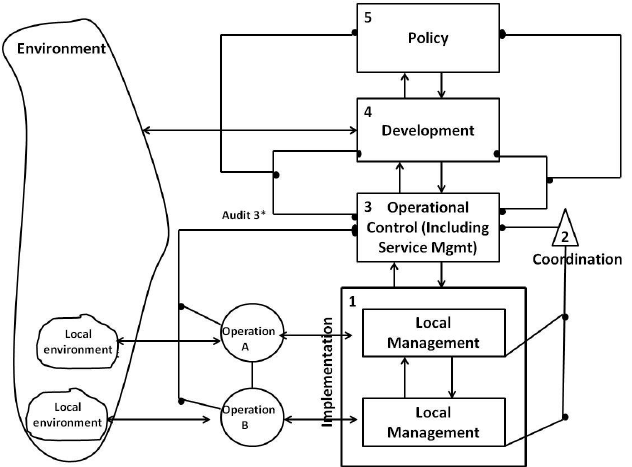
A Viable System Model framing

From a cybernetics systems perspective (which IMO helps organizations understand how to balance control, learning, and adaptability), we could say:

  • The councils represents System 1 role (by delivering specific mandates)
  • The Support Squad aligns with System 2 (operational stability and information flow).
  • The EOC plays a System 3 role (oversight and coordination).
  • Together, they can enable System 4 (organizational learning and strategic adaptation).

That is to say, rather than building everything into a single body, having distinct but interdependent systems can increase clarity, reduce overload, and create healthier interfaces.

By the way, this idea has some kind of precedent in DAOs. In Optimism, there are (support) roles like GrantNERDs, GovNERDs, SupportNERDs, NumbaNERDs, etc. who act as ā€œcivil servantsā€ offering public service outside of councils (representative structures), while still being accountable to them.


On learning and adaptation

To make this actionable, the pilot could be framed as part of the EOC’s broader learning architecture, testing whether a shared coordination layer between councils improves effectiveness and reduces fragmentation.

We can also design this with built-in evaluation and handoff mechanisms, so that it doesn’t create overdependence nor permanence.

If the pilot is not useful, the tools or templates created by the Support Squad can be offered to councils to manage independently or be integrated into EOC monitoring tools.

The spirit here is to test something small and useful, not to impose a new structure. If this pilot helps reduce friction, improve documentation, and strengthen cross-council learning, that’s a win.

If not, we can stop or redesign it, together.

:heart_hands:

5 Likes

Is this not redundant with the Foundation’s role already?

In any case, I would storngly suggest using more standard terminology for roles. Creating our own world of terms will drastically reduce accesibility of the DAO

2 Likes

Just wanted to drop a quick update here:

Arbitrum recently launched OpCo, which is essentially their own version of a support squad: handling operations, staffing, and coordination under DAO oversight.

It’s a strong validation that this type of system isn’t just a ā€œnice-to-have,ā€ it’s a critical piece for scaling operations.

Regarding the names, I believe it’s better to have something unique that resonates with our internal culture, rather than copying others… but I’m open to any adaptations you guys suggest.

Anyway, I would love to keep building on this with others who want to see Scroll run smoother without becoming overly corporate.

5 Likes

Yes, the Arbitrum DAO OpCo model is definitely something to consider for Scroll, or at least the initial intent of it. Currently it’s still such a new and WIP shift, that they are still trying to figure it out. Regardless, keeping an eye on their lessons learned will be interested for what we decide for the Scroll DAO.

3 Likes

Hey @alexsotodigital OpCo = Operational Company, very different in nature from a support squad.

The goal of the OpCo is to operationalize the DAO and make it more market competitive, efficient and other aspects I won’t go into detail here.

I do believe Scroll needs something to act like ā€œglueā€ between different councils, initatives, etc but would probably be best to scope the future of those councils, review their outputs and them come back to this again

2 Likes

Totally hear you @ZER8, and maybe this is just a ā€˜naming thing’ we can align on…

What we called ā€œSupport Squadā€ (for now) is essentially System 2: the generic ops backbone that enables all other units to move faster and more coherently. This could be: comms, docs, finance ops, reporting, etc.

That’s what is emerging in OpCo too.

That which is a ā€˜generic’ need for all ā€˜initiatives’ belongs here, leaving the ā€˜specifics’ to the roles of the working team.

Weaver(comms) + Scribe(docs) are just the first roles we thought based on Scroll’s needs at that moment. However, we could create new ones and/or modify them as we see fit. Thats the beauty. :sparkles:

Open to renaming any if it better reflects the function.
Happy to jam on that.

:call_me_hand:

2 Likes

100% agree with this. A best practice is for each council to maintain a dedicated section of the forum for posting their call notes and recordings. Most teams already use AI tools for note taking, action item tracking, and insight generation, so it’s just a matter of consistently uploading this documentation to the forum.

1 Like

Exactly. The core motivation behind Arbitrum’s OpCo is to establish a DAO-aligned operational arm—structured as a legal entity—to address coordination challenges and improve execution efficiency. Scroll DAO, however, is significantly smaller, and the stated intention for its new governance structure is to remain lean and agile.

Introducing an OpCo at this stage would add organizational overhead and long-term commitments before such scale is necessary. Additionally, the Foundation is currently operating in an OpCo-like capacity, which further reduces the immediate need for a separate entity.

1 Like